
Small Game Seasons™ Basics: Featured Game Birds (And why a Thrush?)
Updated: May 10

The Small Game Seasons Prototype features a selection of game bird species chosen to demonstrate specific hunting styles and simulation mechanics. While a separate blog post is dedicated to the bird that started it all—the Ruffed Grouse—this article introduces the other birds that took shape after I was satisfied with the grouse’s behavior and realism in the prototype.
Before diving into each species, it’s important to note that all birds featured in the prototype are third-party 3D models and animations, sourced with valid licenses from asset creators—mainly from the FAB marketplace. These assets vary in refinement, but for prototyping purposes, they gave me exactly what I needed to simulate the different regional hunting styles I wanted Small Game Seasons to explore.
Also, one might wonder whether Small Game Seasons is only meant to simulate upland hunting. The short answer is: not at all. While the earliest expansion of the project naturally focused on upland bird species and hunting scenarios, this was simply a logical starting point—not a limitation.
So, does that mean waterfowl will never make it into Small Game Seasons? Waterfowl are part of the full vision for the game. In fact, a waterfowl scenario may even be added to the prototype in the near future—especially as I continue presenting the concept to publishers and studios.
The Ruffed Grouse
For those unfamiliar with its native range or new to upland hunting, the Ruffed Grouse is often called the “King of the Uplands” in North America. But for hunters, it’s known for something more visceral: its explosive, unpredictable flush.

I chose the grouse because it's a personal passion—something I’ve written about before on this site—and because it’s the perfect example of a reflex-based flush shot.
Whether you're hunting solo or following a pointing dog, a grouse explodes out of cover like a feathered missile, often with a thunderous roar of wings, darting low through dense trees and vanishing almost instantly.
You can read more about this unique species and how it helped shape Small Game Seasons here.
The American Woodcock
In Small Game Seasons, the American Woodcock shares a destination with the Ruffed Grouse—naturally, since the two often inhabit the same young forests in eastern North America.
Though it hasn’t appeared in many hunting games since Bird Hunting: Upland Edition, I felt strongly about including it.

In real life, my encounters with woodcock have been rare, mostly because I don’t hunt with a dog. This bird will hold incredibly still in cover, relying on its camouflage until you're just steps away—a behavior that makes it elusive for solo hunters like me.

Also unlike the grouse, the woodcock is migratory, offering only a short fall window for hunters here in eastern Canada. In Small |Game Seasons, I reflected this seasonality: you’re more likely to flush woodcock in early October than later in the season.
Behaviorally, it contrasts sharply with the grouse. The woodcock tends to flush with a steep, fluttery rise, especially in open terrain. It emits a high-pitched wing whistle, softer and more graceful than the grouse’s sudden thunder. These flight characteristics give players a slightly better chance to react—especially valuable for newer players learning the timing of flush shooting.
The Ring-necked Pheasant (Driven Style)
Also known as the Common Pheasant, this species is renowned for its fast, high flight and is a staple of driven shooting traditions in the UK and Europe.

In the U.S., pheasants are typically hunted in farmland or grasslands, flushed by hunters and dogs. But I chose to represent the driven pheasant scenario in Small Game Seasons for two reasons:
I had already modeled two flushed game birds (grouse and woodcock). Driven shooting offers a sharp contrast in pace, structure, and challenge.
Driven pheasant shooting, despite its heritage and skill requirements, is rarely represented in hunting games.
While driven shoots are occasionally debated—especially between European and North American hunting cultures—I wanted to showcase it respectfully. Personally, I come from an upland hunting background where you walk for hours hoping to flush a single grouse. Still, I believe every hunting style should be practiced ethically, with sustainability and respect for the animal, especially when it comes to recovering and consuming harvested birds.
In Small Game Seasons, pheasants are simulated in flight during their optimum cruise speed, combining bursts of wingbeats and glides. They're fast, and that speed—especially when crossing open corridors—makes them perfect for practicing leads and timing. One prototype drive features birds flying across a clearing between tree lines, echoing real-world shooting lines.
Looking ahead, I also envision adding a U.S. destination where pheasants are hunted in a more familiar walk-up style.
The Thrush (But Why?)
Just like the driven pheasant scenario, I wanted to showcase a hunting style that isn’t often seen in games. And I couldn’t ignore my Mediterranean roots—especially the memories of my father and uncle taking me bird hunting for thrushes, wood pigeons, and quails when I was a child.
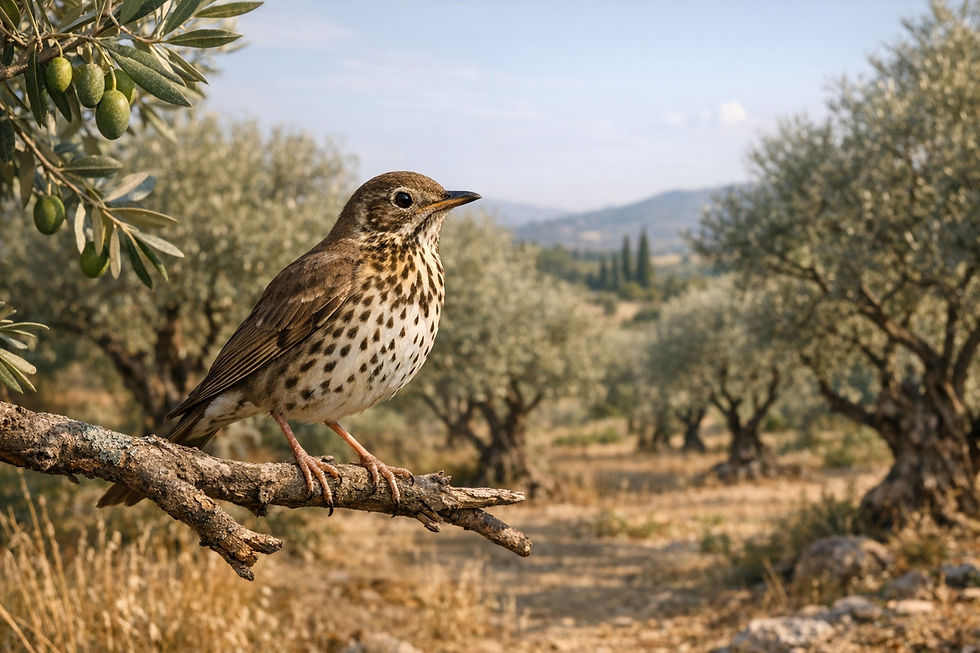
In fact, the Mediterranean region is rich with migratory game birds and hunting traditions, each with its own set of challenges—and, of course, recipes. Among these birds, the Song Thrush holds a special place in several countries around the Mediterranean, where some species are legally hunted during fall migrations.
For many North American hunters, the idea of hunting a small bird like the thrush may seem unusual, even controversial. But in parts of Europe, this is a time-honored and regulated tradition.
In Small Game Seasons, I feature the Song Thrush in a Spanish destination, inspired by the late-afternoon passages I remember. These birds can fly like little jets, crossing olive groves and vineyards as they head toward their roosts in the upper hillside trees.
I didn’t compromise on this bird’s speed or behavior. Just like in real life, virtual hunters in Small Game Seasons need to stay hidden until the bird is in range—especially if the bird perception system is enabled in the simulation settings. The game also includes two types of thrush calls, giving players a way to draw birds closer before they pass out of reach.
The Wood Pigeon
The Wood Pigeon, another migratory species, shares the Spanish destination with the thrush.
Including it in Small Game Seasons made sense for two reasons: it’s a key game bird in parts of Europe, and more importantly, it allowed me to simulate flocking behavior.

Getting the flocking system right was a major technical step in the prototype’s development. While performance limitations required me to tune down flock size for stability, the effect is still faithful to real-world wood pigeon passages. Solo pigeons can also appear occasionally—just like in real hunts.
Wood Pigeons are fast, must stay in formation, and adapt their flight to terrain elevation. Their simulation in Small Game Seasons is tuned to replicate their typical cruise flight pattern.
Unlike the thrush, the wood pigeon cannot be called. But it still demands stealth—especially if the bird perception setting is enabled.
In Europe, wood pigeon decoying is popular, but I chose to keep this bird focused on pass-shooting, leaving decoy-based gameplay for possible future species like ducks or geese.
Conclusion
Each bird species featured in Small Game Seasons was chosen not just for variety, but to represent a specific hunting style, a unique cultural tradition, or a personal connection to my own hunting experiences. From the explosive flush of a Ruffed Grouse to the subtle wing whistle of a Woodcock, the flocking Wood Pigeons, and the lightning-fast Mediterranean Thrush, these birds helped me prototype a wide range of mechanics while staying rooted in authentic hunting behaviors.
More species may be added to future destinations, but these early ones gave Small Game Seasons its wings—literally and figuratively.
If you're curious about what choke or shot size to use for each bird species featured in Small Game Seasons, check out the companion article on Shells, Chokes, and Ballistics.
References & Guidelines
Disclaimer: The following resources, links, and references are shared for context and inspiration. They are unrelated to the Small Game Seasons prototype, which is entirely fictional and not affiliated with, endorsed by, or representing any real organizations, brands, or publications.
For more detailed information about the featured bird species, you can visit:
Ruffed Grouse
American Woodcock
Ring-necked Pheasant
Song Thrush
Wood Pigeon