
Small Game Seasons™ POC Destinations: Bois-Mulé Wildlife Reserve
Updated: Mar 14

In developing Small Game Seasons, the creative process followed a clear and intentional path: I began by selecting a wing-shooting style to simulate, identified a suitable game bird for that style, then established a fictional hunting destination that mirrored its real-world habitat.
The Ruffed Grouse, the first species I simulated, was a natural choice—both technically and personally. Drawing from years of upland bird hunting in Eastern Canada, and Quebec, I knew that the province’s landscapes offered a perfect inspiration for designing an immersive environment. That’s how the fictional Bois-Mulé Wildlife Reserve came to life.
A Quebec-Inspired, Dense Mixed-Woodland Upland Reserve
Bois-Mulé was designed to evoke the kind of place that bird hunters in Eastern Canada would instantly recognize. From the welcome cabin with a harvest deposit box, to trail markers, wooden bridges, dense thickets, and lakeside crossings, the reserve draws inspiration from the many features found in such publicly managed wildlife areas.

These details weren’t just decorative. They’re meant to reflect the type of environments I’ve experienced during the fall season—immersive spaces where a sudden flush can happen at any moment, and where every trail offers its own unique hunting conditions.
Simulating Fall Phases
One of the unique aspects of upland hunting in this region is the dramatic shift in landscape throughout the season. In just a few weeks, the forest transforms from October’s vibrant foliage, to November’s grey and leafless stillness, and finally to the early snowfalls of late season.

Unfortunately, there are no ready-made biome packs representing Southeastern Canada or New England for Unreal Engine, so I had to adapt. By mixing licensed and free assets from vaguely similar regions, and through extensive testing, I created vegetation and terrain transitions that mirror the progression of the hunting season here. The results were worth the effort—and they enhance both the gameplay challenge and visual immersion.
Crafting the Mood: Environmental Audio and Ambience
Hunting in our woods comes with a very particular atmosphere. Often, there’s an eerie stillness—punctuated only by subtle sounds: a distant jay, the creak of a tree trunk, or wind brushing past branches. I worked to recreate that mood as faithfully as I could through custom sound design—mixing ambient silence with just enough tension to heighten the realism.

There’s a haunted quiet to these woods—broken only when a grouse explodes from the underbrush, forcing your instincts to take over before your thoughts can catch up.
Woodland Species and Seasonal Behavior
In Bois-Mulé, players encounter both Ruffed Grouse and American Woodcock—two species that share the same upland habitats but behave very differently over time.
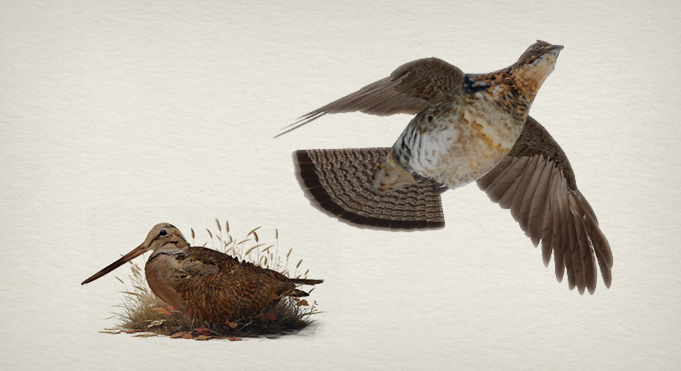
The Woodcock appears more frequently early in the season, during peak color. These birds are small, fast, and fleeting, often vanishing behind a wall of leaves just after flushing. Their characteristic whistling wings and erratic flight patterns offer a unique shooting challenge—especially when the canopy is still full.
The Ruffed Grouse, on the other hand, thrives in all conditions. This master of camouflage adapts to every stage of the season. In early fall, it may burst from thick leaf cover with almost no warning. In winter, it may flush from snow-covered terrain where visibility is higher—but so is the Grouse’s cunning ability to vanish into shadowy understory.
Each phase of the season shifts the balance of visibility, cover, and reaction time—resulting in different challenges and outcomes across the same hunting ground.
A Dynamic, Living Landscape that I’m connected to
More than just a backdrop, the Bois-Mulé Wildlife Reserve was designed as a dynamic environment with selectable seasonal phases—each offering its own challenges and encouraging players to adapt their strategies for true-to-life Ruffed Grouse and American Woodcock hunting scenarios.

By combining personal experience, environmental storytelling, and technically grounded design choices, I aimed to simulate not just a bird or a biome—but a living ecosystem shaped by seasonal change, species behavior, inspired by the spirit of upland bird hunting as I experience it in Quebec every fall.
This reserve laid the groundwork for Small Game Seasons immersive vision and established the tone for the other destinations.
References & Guidelines
Disclaimer: The following resources, links, and references are shared for context and inspiration. They are unrelated to the Small Game Seasons prototype and it destinations, which are entirely fictional and not affiliated with, endorsed by, or representing any real organizations, brands, or publications.
Société des établissements de plein air du Québec – https://www.sepaq.com/
Fondation de la faune du Québec – https://fondationdelafaune.qc.ca/
Territoires fauniques –Territoires fauniques – Gouvernement du Québec
For more information about the Ruffed Grouse and American Woodcock
Ruffed Grouse Society – https://ruffedgrousesociety.org/